66443 Programming Languages
Lecture Notes 4 November 1997
Logic Programming III
- The discussion of unification and backtracking
is based partly on a section of Kenneth C. Loudon, Programming
Languages: Principles and Practice, PWS-KENT Publishing, Boston,
1993.
- In Prolog the goal s = t attempts to unify the terms
s and t. It succeeds if there is a way to assign values
to the variables in both s and t so that the resulting
terms are identical.
| ?- me = me.
yes

| ?- me=you.

no

| ?- me=X.

X = me


| ?- f(a,X) = f(Y,b).

X = b,
Y = a ;
no

| ?- f(X) = g(X).

no

| ?- f(X) = f(a,b).

no

| ?- f(a,g(X)) = f(Y,b).

no

| ?- f(a,g(X)) = f(Y,g(b)).

X = b,
Y = a

| ?- X=Y.
X = _434,
Y = _434
- A term is either a constant, a variable, or a function symbol followed
by a sequence of terms. The last case is called
a structured term and the terms in the sequence
are called the arguments of the term.
- A substitution is a finite set of (variable, term) pairs. Application
of a substitution S = {(v1, t1), . . ., (vn, tn)} to a term t,
written S(t), is defined inductively by
- If t is a constant, S(t) is t.
- If t is a variable, then if it is identical to vi for
some i, 1 <= i <= n, then S(t) is ti; otherwise, S(t) is t.
- If t is a structured term f(u1, . . ., um)
then S(t) is f(S(u1), . . ., S(um)).
- Standard unification algorithm: the inputs are two terms t1 and
t2. The output is either a failure signal or a substitution S
such that S(t1) is identical to S(t2).
- A constant unifies only with itself: me = me succeeds but
me = you fails.
- A variable v that is uninstantiated unifies with any term
that doesn't contain v, and becomes instantiated with that term.
A variable v fails to unify with any term that contains v.
A variable that is already
instantiated is replaced by the term to which it is bound
before proceeding.
- Two structured terms unify
only if both
have the same function name and the same
number of arguments, and the arguments can be unified recursively.
Otherwise the unification fails.
The definition treats both terms symmetrically, in contrast to
ordinary pattern matching, in which one term (the pattern) is allowed
to have variables subject to instantiation, but the other (the
subject) is not. For example, in pattern matching, if f(a,
X) is the pattern and f(Y, b) is the subject, we can
instantiate X to b but not Y to a, so the
match fails. But f(a, X) unifies with f(Y, b) by
instantiating X to b and Y to
a.
Note how repeated occurrences of the same variable are handled.
For example, f(X, h(X)) unifies with f(g(a),
h(g(a))), because when the second X is encountered it is replaced
by g(a), and then h(g(a)) on the left unifies with
h(g(a)) on the right.
In most applications of unification, variables are renamed, if
necessary, so that the two input terms have disjoint sets of
variables. This is done for example in unifying a Prolog goal
or subgoal term with the head term of a rule in the Prolog database.
However, even if this renaming is done initially, it can still
happen that recursive subcases of unification encounter pairs
of terms that have variables in common. For example, . . .
Prolog's unification algorithm famously (or notoriously) differs
from the standard algorithm in one respect: in unifying an
uninstantiated variable v with a term t, it omits the check for v
occurring in t (for the sake of efficiency). Omission of this check,
called the "occurs check," can be considered a bug. (Why? What
problems can it cause?)
- Prolog considers goals left-to-right and clauses in its
database in top-to-bottom order. Subgoals are considered immediately
once they are set up. This search strategy can be viewed as depth-first
search on a tree of possible choices.
- Consider the following clauses:
(1) ancestor(X, Y) :- parent(X, Z), ancestor(Z,Y).
(2) ancestor(X, X).
(3) parent(amy, bob).
Given the goal ancestor(X, bob), Prolog's search strategy is left to
right and depth first on the following tree of subgoals. Edges
are labeled by the number of the clause used by Prolog for
resolution, and instantiations of variables are written in curly
brackets.
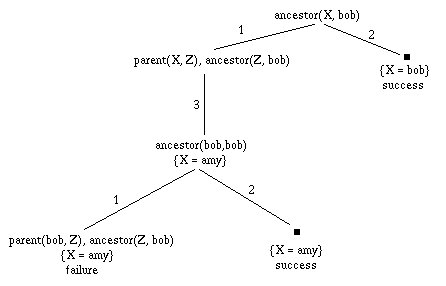
- Leaf nodes in this tree occur either when no match is found for the
leftmost clause or when all clauses have been eliminated, thus
indicating success.
- Whenever failure occurs, or the user indicates a continued search with
a semicolon, Prolog backtracks up the tree to find further paths
to a leaf, releasing instantiations of variables as it does so.
- What are the advantages and disadvantages of this depth-first
strategy? Consider what happens if we rewrite rule (1) as:
(1) ancestor(X, Y) :- ancestor(Z,Y), parent(X, Z).
Consider the appnd predicate, which is
true if its third argument is a list that is the concatenation
of its first two arguments.
appnd([],L,L).
appnd([H | T],L,[H | TL]) :-
           appnd(T,L,TL).
Here are some examples of the use of this predicate:
blackbox.cs.rpi.edu% prolog

Aquarius Prolog version 1.0 top-level (SPARC, SunOS)

| ?- consult('appnd.pro').

yes

| ?- appnd([1], [2, 3], [1, 2, 3]).

yes

| ?- appnd([1], [2, 3], [1, 2, 4]).

no

| ?- appnd([1], X, [1, 2, 4]).

X = [2,4] ;

no
Here the semicolon was typed by the user to cause prolog to search
for further solutions. There were no others. But if we use two
variables we can find all possible combinations of lists whose
concatenation is [1, 2, 4], by typing semicolons until all combinations have
been displayed:
| ?- appnd(X, Y, [1, 2, 4]).

X = [],
Y = [1,2,4] ;

X = [1],
Y = [2,4] ;

X = [1,2],
Y = [4] ;

X = [1,2,4],
Y = [] ;

no

| ?-
A good exercise is to draw the backtracking tree that Prolog
builds in producing these solutions.