Navigation:
Up,
Table of Contents,
Bibliography,
Index,
Title Page
3D Triangulation Data Structure
A geometric triangulation has two aspects: the combinatorial structure, which
gives the incidence and adjacency relations between faces, and the
geometric information related to the position of vertices.
CGAL provides 3D geometric triangulations in which these
two aspects are clearly separated.
As described in Chapter  , a geometric
triangulation of a set of points in is a partition of the
whole space into cells having vertices. Some of them
are infinite, they are obtained by linking an additional vertex at
infinity to each facet of the convex hull of the points (see
Section ).
The underlying combinatorial graph of such a triangulation
without boundary of can be seen as a triangulation of the
topological sphere in .
, a geometric
triangulation of a set of points in is a partition of the
whole space into cells having vertices. Some of them
are infinite, they are obtained by linking an additional vertex at
infinity to each facet of the convex hull of the points (see
Section ).
The underlying combinatorial graph of such a triangulation
without boundary of can be seen as a triangulation of the
topological sphere in .
This chapter deals with 3D-triangulation data structures, meant to
maintain the combinatorial information for 3D-geometric
triangulations. The reader interested in geometric triangulations of
is advised to read Chapter .
Representation
In CGAL, a triangulation data structure is a
container of cells (-faces) and vertices (-faces). Each cell gives
access to its four incident vertices and to its four adjacent
cells. Each vertex gives direct access to one of its incident cells, which is
sufficient to retrieve all the incident cells when needed.
The four vertices of a cell are indexed with 0, 1, 2 and 3. The
neighbors of a cell are also indexed with 0, 1, 2, 3
in such a way that the neighbor indexed by is opposite to the vertex
with the same index (see Figure ).
Figure: Representation.
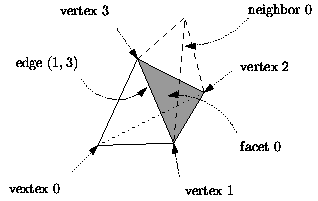
Edges (-faces) and facets (-faces) are not explicitly
represented: a facet is given by a cell and an index (the facet
i of a cell c is the facet of c that is opposite to
the vertex of index i) and an edge is given by a cell and two
indices (the edge (i,j) of a cell c is the edge
whose endpoints are the vertices of indices i and j of
c).
Degenerate Dimensions As CGAL explicitly deals with all degenerate cases, a
3D-triangulation data structure in CGAL can handle the cases when
the dimension of the triangulation is lower than 3.
Thus, a 3D-triangulation data structure can store a triangulation of a
topological sphere of , for any .
Let us give, for each dimension, the example corresponding to the
triangulation data structure having a minimal number of vertices, i.e. a
simplex. These examples are illustrated by presenting their usual
geometric embedding.
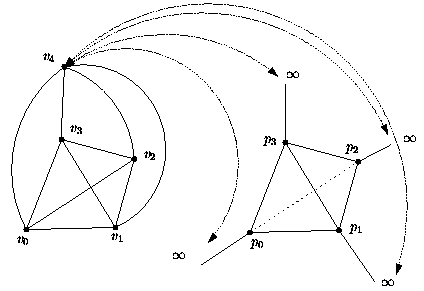
- dimension 3. The triangulation data structure consists of
the boundary of a 4-dimensional simplex, which has 5 vertices. A
geometric embedding consists in choosing one of these vertices to be
infinite, thus four of the five 3-cells become infinite: the geometric
triangulation has one finite tetrahedron remaining, each of its facets
being incident to an infinite cell. See Figure .
Figure: 4D simplex and a 3D geometric embedding.
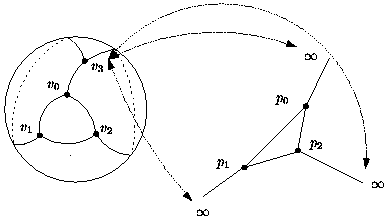
- dimension 2. We have 4 vertices forming one 3-dimensional
simplex, i.e. the boundary of a tetrahedron. The geometric embedding in
the plane results from choosing one of these vertices to be infinite,
then the geometric triangulation has one finite triangle whose edges are
incident to the infinite triangles. See Figure .
Figure: 3D simplex and a 2D geometric embedding.
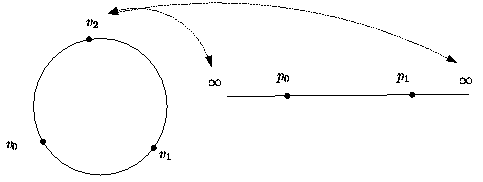
- dimension 1. A 2-dimensional simplex (a triangle) has 3
vertices. The geometric embedding is and edge whose vertices are linked
to an infinite point. See Figure .
Figure: 2D simplex and a 1D geometric embedding.
The last three cases are defined uniquely:
- dimension 0. A 0-dimensional triangulation is
combinatorially equivalent to the boundary of a 1-dimensional simplex
(an edge), which consists of 2 vertices. One of them becomes infinite
in the geometric embedding, and there is only one finite vertex
remaining. The two vertices are adjacent.
- dimension -1. This dimension is a convention to represent a
0-dimensional simplex, that is a sole vertex, which will be
geometrically embedded as an ``empty'' triangulation, having only one
infinite vertex.
- dimension -2. This is also a convention. The
triangulation data structure has no vertex. There is no associated
geometric triangulation.
Note that the notion of infinite vertex has no meaning for the
triangulation data structure. The infinite vertex of the geometric
embedding is a vertex that cannot be distinguished from the other
vertices in the combinatorial triangulation.
The implicit representation of facets (resp. edges) still holds
for degenerate () dimensions : in dimension 2, each cell has only one
facet of index 3, and 3 edges , and ; in
dimension 1, each cell has one edge .
Validity A 3D combinatorial triangulation is said to be locally valid
iff the following is true:
(a) When a cell has a neighbor pointer to another cell ,
then reciprocally this cell has a neighbor pointer to , and
and have three vertices in common. These cells are called
adjacent.
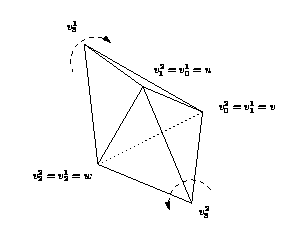
(b) The cells have a coherent orientation: if two cells
and are adjacent and share a facet with vertices , then
the vertices of are numbered , and the vertices of are numbered , up to positive permutations of . In
other words, if we embed the triangulation in , then the fourth
vertices and of and see the common facet
in opposite orientations. See Figure .
The set of permutations of
has cardinality 24, and the set of positive permutations
has cardinality 12. Thus, for a given orientation, there
are up to 12 different orderings of the four vertices of a cell. Note
that circular permutations are negative and so do not preserve the
orientation of a cell.
Figure: Coherent orientations of two cells (3-dimensional case).
The is_valid() method provided by
Triangulation_data_structure_3 checks the local validity of a
given triangulation data structure.
Software Design
The 3D-triangulation data structure class of CGAL is designed to be
used as a combinatorial layer upon which a geometric layer can be
built [Ket98]. This upper class can be the 3D-triangulation
class of CGAL. Figure shows the organization of
the software design in this case.
Figure: Layers in the software design.

In the bottom layer, the CGAL base classes store elementary
geometric information. These classes are parameterized by a geometric
traits class providing all the geometric types. A vertex has a pointer
to a cell, and a cell has four pointers to vertices. These pointers
are of type void*.
The middle layer class stores the triangulation data structure, which
is purely combinatorial. A vertex of the triangulation data structure
has a pointer to a cell of the triangulation data structure, and a
cell has four pointers to vertices. These pointers are usual
C++ pointers. The triangulation data structure provides
operations such as insertion of a new vertex in a given cell, on a
or -face. It also allows one, if the dimension of the triangulation
is smaller than , to insert a vertex so that the dimension of the
triangulation is increased by one. The triangulation data
structure is responsible for the combinatorial integrity of the
triangulation.
It is up to the user to derive his own base classes from the CGAL base classes to add any other information he may need for his given
application, or to write his own base classes from scratch. In this
case, the base classes must be models for the concepts described in
Triangulation_vb_3 and Triangulation_cb_3.
The upper layer, described in Chapter , is
the geometric triangulation class, providing operations such as
location of a point in the triangulation, insertion of a point, and is
responsible for the geometric validity. A vertex of the triangulation
has a pointer to a cell and a cell has four pointers to
vertices. These pointers are CGAL handles. The triangulation
data structure class is one of the template parameters of the
geometric triangulation class. The user may choose to replace the
CGAL triangulation data structure class by his own triangulation
data structure. In this case, his class has to be a model of the
concept described in .
Example of incremental construction
The following example shows how to construct a 3D triangulation data
structure by inserting vertices.
// Triangulation_3/example_tds.C
#include <CGAL/Triangulation_cell_base_3.h>
#include <CGAL/Triangulation_vertex_base_3.h>
#include <CGAL/Triangulation_data_structure_3.h>

#include <iostream>
#include <fstream>
#include <cassert>
#include <vector>

// We define a minimal traits class, because the Point_3 type is needed in
// order to instantiate Triangulation_vertex_base_3<>.

class empty_traits {
public:
  class Point_3 {};
};
typedef empty_traits K;

typedef CGAL::Triangulation_vertex_base_3<K>       Vb;
typedef CGAL::Triangulation_cell_base_3<K>         Cb;

typedef CGAL::Triangulation_data_structure_3<Vb,Cb> Tds;

typedef Tds::Cell                                   TDSCell;
typedef Tds::Vertex                                 TDSVertex;

int main()
{
  Tds T;

  assert( T.number_of_vertices() == 0 );
  assert( T.dimension() == -2 );
  assert( T.is_valid() );

  std::vector<TDSVertex*> PV(7);

  PV[0] = T.insert_increase_dimension(NULL);
  assert( T.number_of_vertices() == 1 );
  assert( T.dimension() == -1 );
  assert( T.is_valid() );

  int i;
  // each of the following insertions of vertices increases the dimension
  for ( i=1; i<5; i++ ) {
    PV[i] = T.insert_increase_dimension(NULL, PV[0]);
    assert( T.number_of_vertices() == i+1 );
    assert( T.dimension() == i-1 );
    assert( T.is_valid() );
  }
  assert( T.number_of_cells() == 5 );

  // we now have a simplex in dimension 4

  // cell incident to PV[0]
  TDSCell* c = PV[0]->cell();
  int ind;
  assert( c->has_vertex( PV[0], ind ) );
  // PV[0] is the vertex of index ind in c

  // insertion of a new vertex in the facet opposite to PV[0]
  PV[5] = T.insert_in_facet(NULL, c, ind);

  assert( T.number_of_vertices() == 6 );
  assert( T.dimension() == 3 );
  assert( T.is_valid() );

  // insertion of a new vertex in c
  PV[6] = T.insert_in_cell(NULL, c);

  assert( T.number_of_vertices() == 7 );
  assert( T.dimension() == 3 );
  assert( T.is_valid() );

  std::ofstream oFileT("output_tds",std::ios::out);
  // writing file output_tds;
  oFileT << T;

  return 0;
}
Navigation:
Up,
Table of Contents,
Bibliography,
Index,
Title Page
www.cgal.org. Aug 13, 2001.