Navigation:
Up,
Table of Contents,
Bibliography,
Index,
Title Page
2D Triangulations
This chapter describes the two dimensional triangulations
of CGAL. After a few definitions in
section  ,
the overall software
design of the 2D triangulation package is described
in section .
The next sections present the different two dimensional triangulations classes
available in CGAL :
basic triangulations (section ),
Delaunay triangulations
(section ),
regular triangulations
(section ),
constrained triangulations
(section ),
and Delaunay constrained triangulations
(section ).
At last, the section
described a hierarchical data structure for
fast point location queries.
,
the overall software
design of the 2D triangulation package is described
in section .
The next sections present the different two dimensional triangulations classes
available in CGAL :
basic triangulations (section ),
Delaunay triangulations
(section ),
regular triangulations
(section ),
constrained triangulations
(section ),
and Delaunay constrained triangulations
(section ).
At last, the section
described a hierarchical data structure for
fast point location queries.
Definitions
A two-dimensional triangulation is a set of simplices of dimension 0,
1 or 2, called respectively vertices, edges and facets,
such that :
- any face of a simplex in is a simplex in
- any simplex in is a face of a facet in
- two simplices in are either disjoints,
or incident (meaning that one is a subface of the other)
or they share a common lower dimensional face.
- the set of facets in is connected for the adjacency relation,
where two facets
are said to be adjacent if they
share a common edge.
Each facet of a triangulation can be given an orientation
which in turn induces an orientation
on the edges incident to that facet. The orientation of two adjacent
facets are said to be consistent if they induce
opposite orientations on their common incident edge.
A triangulation is said to be orientable if
the orientation of each facet can be chosen in such a way
that all pairs of incident facets have consistent orientations.
The two-dimensional triangulations represented in CGAL are orientable triangulations
embedded in a plane or in a higher dimensional space.
Strictly speaking, the term face should be used
to design a face of any dimension,
and the two-dimensional faces of a triangulation
should be properly called facets.
However, following a common usage, we hereafter often call faces, the facets
of a two dimensional triangulation.
Software Design
Because a triangulation is merely a set of
triangular faces with constant-size complexity,
triangulations are not implemented
as a layer on top of a planar map.
CGAL uses a proper internal
representation of triangulations based on faces and vertices
rather than on edges. Such a representation
saves storage space and results in faster
algorithms [BDuY00].
Thus the basic elements of the representation are vertices and faces.
Each triangular face gives access to its three incident vertices
and to its three adjacent faces.
Each vertex gives access to one of its incident faces
and through that face to the circular list of its incident faces.
The edges are not explicitly represented, they are only represented
through the adjacency relations of two faces.
Figure: The three-layer design of triangulations.
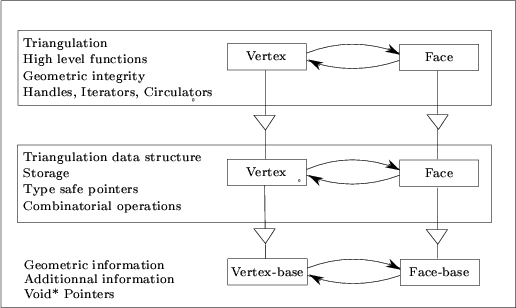
The triangulations in CGAL are represented
by a three-layer structure analogous to the design used for polyhedral
surfaces, see Figure .
The bottom layer is made of the base classes for vertices and faces.
These base classes store some
geometric informations such as the coordinate of vertices
and any other attribute (such as a color, or boolean marks
for constrained edges etc.)
needed by the application.
The base classes handle
incidence and adjacency relations in term of void* pointers.
The use of void* pointers in the bottom layer
makes easy
the change of one of the base
classes, to deal with an extra attribute like a color for example.
The second layer is the triangulation data structure
which can be can be thought
of as a container for faces and vertices
and takes care
of all the combinatorial aspects of the triangulation.
The triangulation data structure restores strong type checking,
implementing adjacency and incidence relations
with type safe pointer operations.
For that purpose, the triangulation data structure defines its own face and vertex
classes which are derived
from the corresponding
base classes
so that geometric and additional information on vertices and faces
are simply inherited.
At last, the top layer, is the triangulation class
which implements the user interface
and is responsible for the geometric embedding of the triangulation.
This class offers to the user
the high level functionalities that can be expected from a triangulation:
insertion or removal of a vertex, traversal of the faces,
enumeration of the vertices,
traversal of the faces incident to a given vertex, location of a given point etc.
The triangulation class defines its own
vertex and face classes
derived from the corresponding class of the triangulation data structure.
The vertices and faces of the triangulation class
are only accessed through high levels concepts such as
handles, iterators, or circulators,
according to the required functionalities of the access.
Being responsible for the geometric embedding
the triangulation class
comes in different flavors according to the kind of triangulation represented:
basic, Delaunay, regular, constrained or constrained Delaunay
triangulations etc.
The triangulation classes of CGAL depend on two template parameters.
The first template parameter stands for
a geometric traits class which is assumed to provide
the geometric objects (points, segments and triangles)
forming the triangulation and the geometric predicates on those objects.
The second template parameter stands for a model
of triangulation data
structure acting as a container for faces and vertices
while taking care of the combinatorial aspects of the triangulation.
The triangulation data structure class is itself a template
class parametrized by the base classes for faces and vertices.
Basic Triangulations
Description
The class Triangulation_2<Traits,Tds>
serves as a base class for all
planar embedded two-dimensional triangulations
in CGAL.
This class expects a model of geometric traits class
as first template argument and a model of triangulation data structure
as second argument. The requirements for the geometric traits
are described later in this section.
The concept of
triangulation data structure and some models for this concept are
described in chapter .
CGAL provides a default for the triangulation data structure
template argument.
The class Triangulation_2<Traits,Tds>
is designed to represent triangulations
of a sets of points in the plane.
Lets be a planar set of points.
A triangulation of the set has vertices at the points of
and its domain covers the convex hull of .
It can be viewed as a planar partition of the plane
whose bounded faces are triangular and cover
the convex hull of . The single unbounded face of this partition
is the complementary of the convex hull of .
In many applications, such as Kirkpatrick's hierarchy
or incremental Delaunay construction, it is convenient to
deal with only triangular faces. Therefore, we add to the
triangulation
a fictitious vertex, called the infinite vertex
and we make each convex hull edge incident
to an infinite
face having as third vertex the infinite vertex.
In that way, each edge is incident to exactly two faces
and special cases at the
boundary of the convex hull are simpler to deal with.
In the following, we called infinite the infinite vertex
and any face or edge
incident to the infinite vertex. Any face or edge non incident
to the infinite vertex as well as any vertex different from
the infinite vertex is said to be finite.
Although it is convenient to draw a triangulation as in
figure , note that
the infinite vertex has no significant
coordinates and that no geometric predicate can be applied on it
or on an infinite face.
Figure: The infinite vertex.
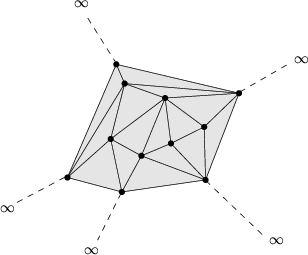
A triangulation is represented as a collection of vertices and faces that
are linked together through incidence and adjacency relations.
Each face gives access to its three incident vertices and to
its
three adjacent faces. Each vertex gives access to one of its incident
faces.
The three vertices of a face are indexed with 0, 1 and 2
in counterclockwise order. The neighbor of a face are also
indexed with 0,1,2 in such a way that the neighbor indexed by i
is opposite to the vertex with the same index.
The edges are only implicitly represented
through the adjacency relations between their two incident
faces. Each edge has two implicit representations : the edge
of a face f which is opposed to the vertex indexed i,
can be represented as well as an edge of the neighbor(i) of
f.
Many of the classes in the triangulation package
offer two functions int cw(int i) and
int ccw(int i)
which given the index of a vertex in a face
compute the index of the next vertex of the same face
in clockwise
or counterclockwise order.
Thus, for example the neighbor
neighbor(cw(i)) is
the
neighbor of f which is next to neighbor(i) turning clockwise
around f. The face neighbor(cw(i))
is also the first face encountered after f when
turning clockwise around vertex i
of f. See Figure .
Figure: Vertices and neighbors.
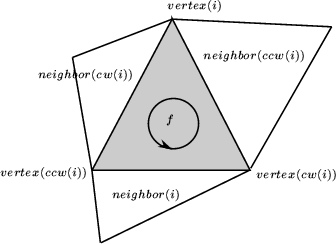
The vertices and faces of the triangulations are accessed through
handles1,
iterators and circulators.
Handles are used whenever the accessed element
is not part of a sequence,
iterators and circulators are used
to visit parts of the triangulation.
The triangulation class offers
some iterators to visit all the (finite or infinite)
faces, edges or vertices and also iterators to visit all the finite
faces, edges or vertices.
The triangulation offers circulators
to visit the edges or faces
incident to a given vertex or the vertices
adjacent to it. It also provides a circulator type
to visit all the faces
traversed by a given line.
Circulators step through infinite features as well as
through finite ones.
The iterators and circulators
are all bidirectional and non mutable.
The circulators and iterators are assignable to the
corresponding handle types.
When calling a member function,
any handle type argument can be replaced
by an iterator or a circulator
with the same value type.
The triangulation class provides methods to test
the infinite character of any feature,
and also methods to test the presence in the triangulation
of a particular feature (edge or face) given its vertices.
The triangulation class provides a method to locate
a given point with respect to a triangulation.
In particular, this method reports wether the point
coincides with a vertex of the triangulation, lies on an edge,
in a face or outside of the convex hull. In case of a degenerate
lower dimensional triangulation, the query point may also lie
outside the triangulation affine hull.
The triangulation class also provides
methods to locate a point with respect to
a given finite face of the triangulation or with respect to its
circumcircle.
The faces of the triangulation and their circimcircles
have the counterclockwise orientation.
The triangulation can be modified by several functions :
insertion of a point, removal of a vertex,
flipping of an edge. The flipping of an edge
is possible when the union of the two incident faces
forms a convex body (see Figure ).
Figure: Flip.
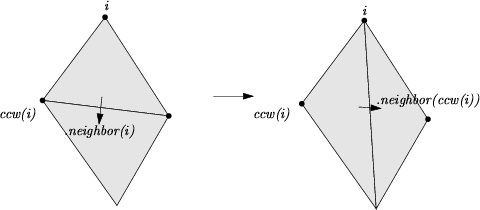
Implementation
Locate is implemented by a line walk. The walk
begins at a vertex of the face which
is given
as an optional argument or at an arbitrary vertex of the triangulation
if no optional argument is given. It takes
time O(n) in the worst case, but only O(sqrt(n))
on average if the vertices are distributed uniformly at random.
The class Triangulation_hierarchy_2<Traits,Tds>,
described in section ,
implements a data structure designed to
offer an alternate more efficient point location algorithm.
Insertion of a point is done by locating a face that contains the
point, and then splitting this face.
If the point falls outside the convex hull, the triangulation
is restored by flips. Apart from the location, insertion takes a
time O(1). This bound is only an amortized bound
for points located outside the convex hull.
Removal of a vertex is done by removing all adjacent triangles, and
retriangulating the hole. Removal takes a time at most proportionnal to
d^2, where
d is the degree of the removed vertex,
which is O(1) for a random vertex.
The face, edge, and vertex iterators on finite features
are derived from their counterparts visiting all (finite and infinite)
features which are themselves derived from the corresponding iterators
of the triangulation data structure.
Geometric Traits
The first template parameter of the triangulation classes of CGAL
is a geometric traits class. This parameter has to be instanciated by
a model of the concept
TriangulationTraits_2 described of the reference manual.
The geometric traits class
is required to provide
the geometric objects (points, segments and triangles)
building up the triangulation
together with the geometric predicates on those objects.
The required predicates are:
- comparison of the x or y coordinates of two points.
- orientation tests providing CGAL_orientation
corresponding to the order type of three given point.
The CGAL kernel classes Homogeneous<Nt> and
Cartesian<Nt>,
templated by the number type Nt
are models of the concept TriangulationTraits_2.
The CGAL library provides other models
of TriangulationTraits_2
using the kernel geometric objects and predicates.
These classes are themselves templated with a representation class.
The traits class Triangulation_euclidean_traits_2<R>
is designed to deal with ordinary two dimensional points.
The class Triangulation_euclidean_traits_xy_3<R>
is a geometric traits class to build the triangulation
of a terrain. Such a triangulation is a two-dimensional
triangulation embedded the three-dimensional space.
The data points are three-dimensional points.
The triangulation is
build according to the projections of those points
on the plane and then lifted up to the original
three-dimensional data points.
This is the usual case when dealing with GIS terrains.
Instead of really projecting the three-dimensional points and
maintaining a mapping between each point and its projection
(which costs space and is error prone),
the traits class supplies geometric predicates that ignore the
z-coordinates of the points.
CGAL provides also the geometric traits classes
Triangulation_euclidean_traits_yz_3<R> and
Triangulation_euclidean_traits_zx_3<R> to
deal with projections on the
xz plane and yz-plane,
respectively.
Example of a Basic Triangulation
The following program creates a triangulation of 2D points
using the kernel model class CGAL::Cartesian<double>
as geometric traits and the default triangulation data structure
template parameter.
The input points are read from a file
and inserted in the triangulation.
Finally points on the convex hull are written to cout.
// file          : examples/Triangulation_2/triangulation_prog1.C
#include <CGAL/basic.h>
#include <fstream>

#include <CGAL/Cartesian.h>
#include <CGAL/Triangulation_2.h>

typedef CGAL::Cartesian<double> Gt;
typedef CGAL::Triangulation_2<Gt> Triangulation;
typedef Triangulation::Vertex_circulator Vertex_circulator;
typedef Gt::Point_2   Point;

int main() {
  std::ifstream in("data/triangulation_prog1.cin");
  std::istream_iterator<Point> begin(in);
  std::istream_iterator<Point> end;

  Triangulation t;
  t.insert(begin, end);

  Vertex_circulator vc = t.incident_vertices(t.infinite_vertex()),
    done(vc);
  if (vc != 0) {
    do { std::cout << vc->point() << std::endl;
    }while(++vc != done);
  }
  return 0;
}
Delaunay Triangulations
Description
The class Delaunay_triangulation_2<Traits,Tds> is designed to represent
the Delaunay triangulation of a set of data points in the plane.
A Delaunay triangulation of a set of points
fulfills
the following empty circle property
(also called Delaunay property): the circumscribing
circle of any facets of the triangulation
contains no data point in its interior.
For a point set with no subset of four cocircular points
the Delaunay triangulation is unique, it is the dual
of the Voronoi diagram of the points.
A Delaunay triangulation is a special triangulation of a set of points.
So it is natural to derive
the class Delaunay_triangulation_2<Traits,Tds>
from the basic class Triangulation_2<Traits,Tds>.
Like its base class, the Delaunay triangulation class is parametrized
by two template
parameters, the geometric traits Traits
and the triangulation data structureTds.
Just like the triangulation data structure
of a basic triangulation,
the triangulation data strucure of a Delaunay triangulation
has to be a model of the concept TriangulationDataStructure_2.
In contrast, because the
concept of Delaunay triangulation relies on the notions of
distance and
empty circles,
the geometric traits has to be a model of the concept
DelaunayTriangulationTraits_2
which refines the concept TriangulationTraits_2.
The class Delaunay_triangulation_2<Traits,Tds>
inherits the types defined by the
basic class Triangulation_2<Traits,Tds>.
Additionnal types, provided by the traits class,
are defined to represent the dual Voronoi diagram.
The class Delaunay_triangulation_2<Traits,Tds>
overwrite the member functions that insert a new point
in the triangulation or
or remove a vertex from it
to maintain the Delaunay property.
It also has a member function (Vertex_handle nearest_vertex(const Point& p))
to answer nearest neighbor queries
and member functions to construct the elements (vertices and edges)
of the dual Voronoi diagram.
Geometric traits
The geometric traits has to be a model of the concept
DelaunayTriangulationTraits_2
which refines the concept TriangulationTraits_2.
In particular this concept provides
the in_circle(p,q,r,s) predicate
which decides the position of the point (interior, exterior
or on the boundary) with respect to the circle
passing through , and .
The in_circle(p,q,r,s)
predicate actually defines the Delaunay triangulation.
Changing this predicate
allows to build Delaunay triangulations for different metrics
such that or or any metric defined by a
convex object. However, the user of an exotic metric
must be carefull that the constructed triangulation
has to be a triangulation of the convex hull
which means that convex hull edges have to be Delaunay edges.
This is granted for any smooth convex metric (like )
and can be ensured for other metrics (like )
by the addition to the point set of well chosen sentinel points.
The CGAL kernel classes Homogeneous<Nt> and
Cartesian<Nt>, and the class Triangulation_euclidean_traits_2<R>
are models of the concept DelaunayTriangulationTraits_2
for the euclidean metric.
CGAL also provides traits classes to deal with terrains,
that are two dimensional triangulated surfaces
embedded in the three dimensional space that have project on
a two dimensional Delaunay triangulation. Namely, the traits classes
Triangulation_euclidean_traits_xy_3<R>,
Triangulation_euclidean_traits_yz_3<R>, and
Triangulation_euclidean_traits_zx_3<R>
are to be used to build a a triangulated surface
projecting on the Delaunay triangulation of respectively
the xy, yz or zx projections of its vertices:
The requirements for the duality functions and nearest vertex
queries are not yet satisfied by
these last three classes.
Implementation
The insertion of a new point in the Delaunay triangulation
is performed using first the insertion member function
of the basic triangulation and second
performing a sequence of flips to restore the Delaunay property.
The number of flips that have to be performed is O(d)
if the new vertex has degree d in the updated
Delaunay triangulation. For
points distributed uniformly at random,
each insertion takes time O(1) on
average, once the point has benn located in the triangulation.
Removal calls the removal in the triangulation and then retriangulates
the hole created in such a way that the Delaunay criterion is
satisfied. Removal of a
vertex of degree d takes time O(d^2).
The degree is O(1) for a random
vertex in the triangulation.
After having performed a point location, the
nearest neighbor of a point is found in time O(n) in the
worst case, but in time O(1)
for vertices distributed uniformly at random and any query point.
Example : a Delaunay Terrain
The following code creates a Delaunay triangulation with
the usual Euclidean metric for the vertical projection of a
terrain model. The points have elevation, that is they are 3D points,
but the predicates used to build the Delaunay triangulation
are computed using only the and coordinates
of these points.
// file          : examples/Triangulation_2/terrain.C
#include <CGAL/Homogeneous.h>
#include <fstream>
#include <CGAL/Gmpz.h>
#include <CGAL/Triangulation_euclidean_traits_xy_3.h>
#include <CGAL/Delaunay_triangulation_2.h>

typedef CGAL::Homogeneous<CGAL::Gmpz>  Rp;
typedef CGAL::Triangulation_euclidean_traits_xy_3<Rp>  Gt;
typedef CGAL::Delaunay_triangulation_2<Gt> Delaunay;

typedef Rp::Point_3   Point;

int main()
{
  std::ifstream in("data/terrain.cin");
  std::istream_iterator<Point> begin(in);
  std::istream_iterator<Point> end;

  Delaunay dt;
  dt.insert(begin, end);
  return 0;
}
Example : Voronoi Diagram
The following code computes the edges of Voronoi diagram
of a set of data points
and counts the number of finite edges and the number of rays
of this diagram
// file          : examples/Triangulation_2/voronoi.C
#include <CGAL/basic.h>
#include <fstream>

#include <CGAL/Cartesian.h>
#include <CGAL/Delaunay_triangulation_2.h>

typedef double coord_type;
typedef CGAL::Cartesian<coord_type>  Gt;
typedef CGAL::Delaunay_triangulation_2<Gt>  Triangulation;
typedef Triangulation::Edge_iterator  Edge_iterator;

int main( )
{
  std::ifstream in("data/voronoi.cin");
  std::istream_iterator<Gt::Point_2> begin(in);
  std::istream_iterator<Gt::Point_2> end;
  Triangulation T;
  T.insert(begin, end);

  int ns = 0;
  int nr = 0;
  Edge_iterator eit =T.edges_begin();
  for ( ; eit !=T.edges_end(); ++eit) {
    CGAL::Object o = T.dual(eit);
    Gt::Segment_2 s;
    Gt::Ray_2     r;
    if (CGAL::assign(s,o)) {++ns;}
    if (CGAL::assign(r,o)) {++nr;}
  }
  std::cout << "The voronoi diagram as " << ns << "finite edges "
	    << " and " << nr << " rays" << std::endl;
  return 0;
}
Regular triangulations
Description
Let be a set of
weighted points where each is a point and each
is a scalar called the weight of point .
Alternatively, each weighted point can be regarded
as a sphere (or a circle, depending on the dimensionality
of ) with center and radius .
The power diagram of the set is a space partition in which
each cell corresponds to a sphere of
and is the locus of points whose power with respect to
is less than its power with respect to any other sphere
in . In the two-dimensional space,
the dual of this diagram is a triangulation
whose domain covers the convex hull of the set
of center points
and whose vertices form a subset of .
Such a triangulation is called a regular triangulation.
Three points and of
form a triangle in the regular triangulation of
iff there is a point of the plane with equal
powers with respect to ,
and and such that this power
is less than the power of
with respect to any other sphere in .
Let us defined the power product of two weighted points
and as:
is simply the power of point
with respect to the sphere , and two weighted points
are said to be orthogonal if their power product is null.
The power circle of three weighted points
,
and is defined as the unique circle
orthogonal to
,
and .
The regular triangulation of the sets
satisfies the following regular property (which just reduces to the
Delaunay property when all the weights are null):
a triangle is a face of the regular triangulation
of iff the power product of any weighted point
of with the power circle of
, and is positive or null.
We call power test of , , ,
and , the predicates which amount to compute
the sign of
the power product of with respect to
the power circle of
, and .
This predicate amounts to computing the sign of
the following
determinant
A pair of neighboring faces
and is said to be locally regular
(with respect to the weights in )
if the power test of , , ,
and is positive.
A classical result of computational geometry
establishes that a triangulation of the convex hull of
such that any pair of neighboring faces is regular with respect
to , is a
regular triangulation of .
Alternatively, the regular triangulation
of the weighted points set
can be obtained as the projection
on the two dimensional plane of the convex hull of the set of three
dimensional points
.
The class Regular_triangulation_2<Traits, Tds>
is designed to maintain the
regular triangulation of a set of weighted points.
The template parameters Traits and Tds stand respectively
for a geometric traits class and a triangulation data structure class.
The triangulation data structure has to be a model of the concept
TriangulationDataStructure_2.
The geometric traits class must provide a weighted point type
and a power test on these weighted points
and the concept for this parameter, called
RegularTriangulationTraits_2,
is a refinement of the concept
TriangulationTraits_2. CGAL provides
the class
Regular_triangulation_euclidean_traits_2<Rep,Weight>
which is a model for the traits concept
RegularTriangulationTraits_2.
The class Regular_triangulation_euclidean_traits_2<Rep,Weight>
derives from the class
Triangulation_euclidean_traits_2<Rep>
and uses a Weighted_point type
derived from the type Point_2 of
Triangulation_euclidean_traits_2<Rep>.
The class Regular_triangulation_2<Traits, Tds>
derives from the class Triangulation_2<Traits, Tds>.
The functions insert and
remove are overwritten to maintain the regular
property.
The vertices of the regular triangulation
of a set of weighted points form only a subset
of the set of center points of .
Some of the input
weigthed points have no cell in the dual power diagrams
and therefore do not correspond to a vertex of the regular
triangulation.
Therefore the insertion of a weighted point in a regular triangulation
does not necessarily imply the creation of a new vertex.
Regular triangulation have member functions to construct
the vertices and edges of the dual power diagrams.
The Face Type of a Regular Triangulation
An input point that does not appear as a vertex in the
regular triangulation is said to be hidden
by the face in which the corresponding center point is located.
A point which is hidden at a given time may appear later as a vertex of
the regular triangulation if some other weighted points are removed.
Therefore, hidden points have to be stored somewhere.
A hidden point can appear as vertex of the triangulation
only when the
two dimensional face that hides it
is removed from the triangulation.
Therefore the hidden point are stored
in the faces that hide them and the nested face type of a
regular triangulation is assumed to include a list of hidden
weighted points. This list of weighted point is in fact included
in the base face of a regular triangulation.
Therefore the base face type of a regular triangulation
is required to provide a list of weigthed points,
designed to store the points hidden by the face. It has to be a model
of the concept RegularTriangulationFaceBase_2.
CGAL provides the templated class
Regular_triangulation_face_base_2<Traits>
as a default base class for faces of regular triangulations.
This class derives from Triangulation_face_base_2<Traits>.
Example : a Regular Triangulation
The following code creates a regular triangulation
of a set of weighted points.
// file example/Triangulation_2/regular.C
#include <CGAL/Cartesian.h>
#include <fstream>
#include <CGAL/Regular_triangulation_euclidean_traits_2.h>
#include <CGAL/Regular_triangulation_2.h>

typedef CGAL::Cartesian<double> Rp;
typedef double W;
typedef CGAL::Regular_triangulation_euclidean_traits_2<Rp,W>  Gt;
typedef CGAL::Regular_triangulation_2<Gt> Regular_triangulation;

int main()
{
   Regular_triangulation rt;
   std::ifstream in("data/regular.cin");

   Gt::Weighted_point wp;
   while(in >> wp){
     std::cout << wp << std::endl;
     rt.insert(wp);
   }
   rt.is_valid();
   return 0;
}
Constrained Triangulations
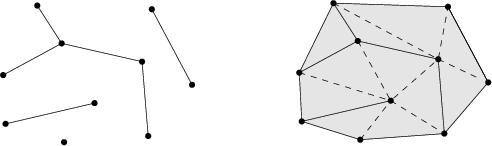
A constrained triangulation is a triangulation of a set of points
that has to include among its edges
a given set of segments joining the points. The corresponding
edges are called constrained edges.
The endpoints of constrained edges are of course vertices of the
triangulation. However the triangulation may include
include other vertices as well. The set of
constrained edges forms a set of segments that do not intersect
except possibly at their endpoints. Any number of constrained edges
are allowed to share the same endpoint. Vertical constrained edges or
constrained edges with null length are allowed.
A constrained triangulation is represented in the CGAL library as an
object of the class Constrained_triangulation_2<Traits,Tds>.
The template parameter Traits
stands for a geometric traits class that has to be a model
of the concept TriangulationTraits_2.
The template parameter Tds
stands for
a triangulation data structure class that has to be a model
of the concept TriangulationDataStructure_2.
The class Constrained_triangulation_2<Traits,Tds>
inherits from Triangulation_2<Traits,Tds>.
It defines an additionnal type Constraint
to represent the constraints. A
constraint is represented as a pair of points.
A constrained triangulation can be created
from a
list of constrained edges.
The class Constrained_triangulation_2<Traits,Tds>
overrides the insertion and removal of a point to take care of the
information about constrained edges. The class also allows inline
insertion of a new constraint, given by its two endpoints
or the removal of a constraint.
The Base Face of a Constrained Triangulation
The information about constrained edges is store in the
faces of the triangulation. Thus the nested Face
type of a constrained triangulation offers
additonnal functionalities to deal with this information.
To achieve this, the base face of a Constrained Triangulation
has to be a model for the concept ConstrainedFaceBase_2
which refines the concept TriangulationFaceBase_2.
The concept ConstrainedFaceBase_2
requires a member function
(bool is_constrained(int i))
providing the status
(constrained ou unconstrained) of the edges
and also a member function
(void set_constraint(int i, bool b)) to set this status.
CGAL provides a default base face class
for constrained triangulations. This class, named
Constrained_triangulation_face_base_2<Traits>,
derives from the class
Triangulation_face_base_2<Traits>
and add three boolean to store the status of its edges.
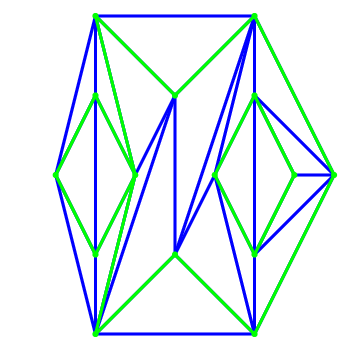
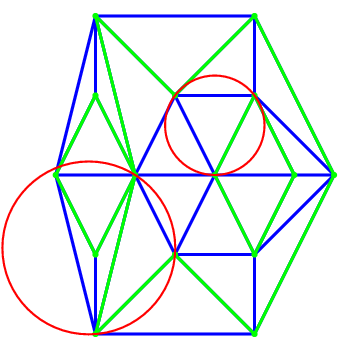
Figure: Constrained and Constrained Delaunay triangulation :
the constraining edges are the green edges, a constrained
triangulation is shown on the left, the constrained Delaunay
triangulation with two examples of circumcircles is shown on the right.
Constrained Delaunay Triangulations
A constrained Delaunay triangulation is a triangulation with
constrained edges which tries to be as much Delaunay as possible.
As constrained edges are not necessarily Delaunay edges,
the triangles of a constrained Delaunay triangulation do not
necessarily fulfill the empty circle property
but they fulfill a weaker constrained empty circle property.
To state this property,
it is convenient to think of constrained
edges as blocking the view. Then, a triangulation is
constrained Delaunay iff
the circumscribing circle
of any facets encloses
no vertex visible
from the interior of the facet.
The CGAL class
Constrained_Delaunay_triangulation_2<Traits,Tds>
is designed to represent
constrained Delaunay triangulations.
The class is templated by a geometric traits class Traits
and a triangulation data structure Tds.
The triangulation data structure has to be a model of the concept
TriangulationDataStructure_2.
The geometric traits
of a constrained Delaunay triangulation is required
to provide the side_of_oriented_circle test as the geometric traits
of a Delaunay triangulation and has to a model of the concept
DelaunayTriangulationTraits_2.
A constrained Delaunay triangulation is not a Delaunay
triangulation but it is a constrained triangulation.
Therefore the class
Constrained_Delaunay_triangulation_2<Traits,Tds>
derives from
the class Constrained_triangulation_2<Traits,Tds>.
Also, information about the status (constrained or not)
of the edges of the triangulation has to be stored
in the face class
and the base face class
of a constrained Delaunay triangulation has to be a model
of ConstrainedFaceBase_2.
The constrained Delaunay triangulation
has member functions to override the
insertion and removal of a point or of a constraint.
Each of those member function takes care
to restore
the constrained empty circle
property.
Example : a constrained Delaunay triangulation
The following code inputs constraining edges from a file
and build a Delaunay constrained triangulation.
// file          : examples/Triangulation_2/constrained.C
#include <CGAL/basic.h>
#include <CGAL/Cartesian.h>
#include <fstream>
#include <list>
#include <CGAL/Constrained_Delaunay_triangulation_2.h>

typedef double Coord_type;
typedef CGAL::Cartesian<Coord_type>  Gt;
typedef Gt::Point_2    Point;
typedef CGAL::Constrained_Delaunay_triangulation_2<Gt>  CDT;
typedef CDT::Constraint     Constraint;

int
main( )
{
  std::ifstream is("data/constrained.cin");
  std::list<Constraint> lc;
  int n;
  Point p,q;
  is >> n;
  std::cerr << "Reading " << n << " constraints" << std::endl;
  for(; n > 0; n--) {
    is >> p >> q;
    lc.push_back(std::make_pair(p,q));
  }

  CDT cdt(lc.begin(),lc.end());
  assert(cdt.is_valid());
  return 0;
}
The Triangulation Hierarchy
The class Triangulation_hierarchy_2<Tr>
implements a triangulation augmented with
a data structure to answer efficiently point location queries.
The data structure is a hierarchy
of triangulations. The triangulation at the lowest level is
the original triangulation where operations and point location are to
be performed.
Then at each succedding level, the data structure
stores a triangulation of a small random sample of the vertices
of the triangulation at the preceeding level. Point location
is done through a top down nearest neighbor query.
The nearest neighbor query is first
performed naively in the top level triangulation.
Then, at each following level, the nearest neighbor at that level
is found through a linear walk performed from
the nearest neighbor found at the preceeding level.
Because the number of vertices in each triangulation is only a small
fraction of the number of vertices of the preceeding triangulation,
the data structure remains small and achieves fast point location
queries on real
data. As proved in [Dev98], this structure has an optimal behaviour
when it is built for Delaunay triangulations.
However it can be used as well for other triangulations
and the class Triangulation_hierarchy_2<Tr> is templated by a parameter
which is to be instantiated by one of the CGAL triangulation
classes. More precisely a triangulation hierarchy can be set for all
two dimensional triangulations of CGAL except for regular triangulations.
The class Triangulation_hierarchy_2<Tr> inherits from the
triangulation type passed as template parameter Tr.
The insert and remove member functions
are overwritten to update the data structure at each operation.
The locate queries are also overwritten to take advantage of the data
structure for a fast processing.
The Vertex of a Triangulation Hierarchy
The vertex of a triangulation used as
the base class of a triangulation hierarchy
has to provide
some pointers to the corresponding vertices in the
triangulations of the next and preceeding levels.
The base vertex class of a triangulation hierarchy
has to be a model of the
concept
TriangulationHierarchyVertexBase_2 which extends
the concept TriangulationVertexBase_2.
This extension adds
access and setting member functions
for two pointers to the corresponding vertices in the
triangulations of the next and preceeding levels.
CGAL provides the class Triangulation_hierarchy_vertex_base_2<Vb>
which is a model for the concept
TriangulationHierarchyVertexBase_2.
This class is templated by a parameter Vb
which is to be instantiated by a model of the concept
TriangulationVertexBase_2.
The class Triangulation_hierarchy_vertex_base_2<Vb> inherits
from its template parameter Vb.
This design allows to use for Vb
either the default
vertex base class or a user customized
vertex base with additionnal functionalities.
Footnotes
|
|
|
1 |
A handle is a type which supports the two
dereference operators operator* and operator->.
|
Navigation:
Up,
Table of Contents,
Bibliography,
Index,
Title Page
www.cgal.org. Aug 13, 2001.